

For those you with an interest in an esoteric backwater of WWII ID model collecting, replicated below is a User Guide on the subject of cardboard training models that I just wrote for Ebay. Please offer suggestions, or let me know if you have anything to add to the lore. Write with any questions. Thanks -- Bryan
With respect to the cardboard "silhouette" recognition training models used during World War II, the Special Devices Section of the US Navy's Bureau of Aeronautics pioneered the concept in 1941. As with much of the USA’s early ID training efforts, the Navy was improving upon ideas developed elsewhere, learning primarily from the British and German experiences which predated our own involvement in World War II by 2+ years. No one knows how many aircraft the US Navy actually modeled. They started with Reference #S-1 and went to at least Reference #S-105. According to published data from the manufacturer, 142 types of cardboard silhouette airplane models were made, but this number might include the same plane made for different branches of the armed forces, since these had different markings (see below). Numbers were assigned in the order in which the models were designed, which sometimes differed from the order in which they were issued. This is as opposed to the “Army/Navy Joint Services” sets, which were organized by country. The earliest known USN date is 2/18/42, more than a year in advance of the "Joint Services" sets issued on 2/22/43. The USN made models of some exotic aircraft such as the Boeing Stratoliner, DC-2, DC-5, O-52 Owl, Lockheed 18, Airspeed Oxford, Avro Anson, JRB-2 Expeditor, A-17A, F2A Buffalo, I-16 Rata, a float-plane version of the SB2U Vindicator, and the bi-plane precursors of the Wildcat (F3F-2), Seagull (SOC-3) and Helldiver (SBC-4). Many of these were never modeled in any other medium. There are plaster models known to exist of the Owl, Buffalo, and Rata, and “schoolboy” wood models of the Rata, Buffalo, SBC-4, SOC-3, and F3F-2, but the others are unique to this genre.
Two Smalls, One Medium, & One Large

Back of Box
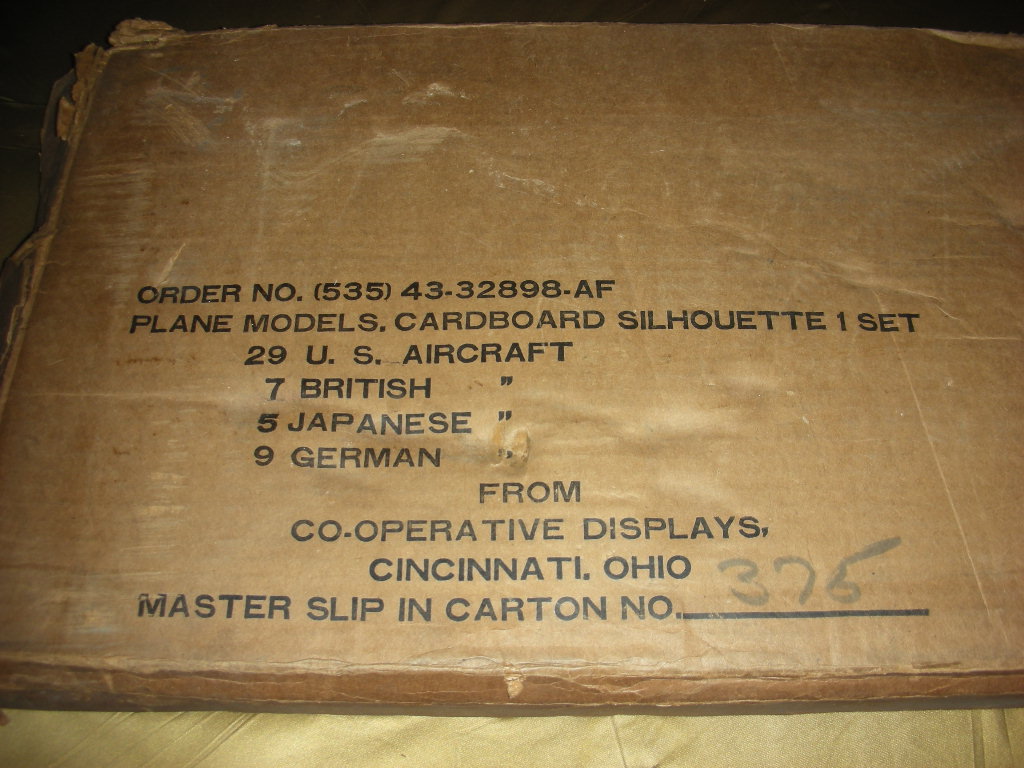
Box Front - 20 lbs for 30 cents!
4,500 Cardboard Models: Union Station, Chicago, 1944
(From LIFE Magazine)

Not content to let the Navy lead anything, the USAAF started to produce a few of the same models under their own aegis. (See below for distinguishing markings.) Eventually the military forces decided to cooperate rather than compete, and the "Joint Services" sets were released. All of these models/sets had a date of 2/22/43. Set "B" had 50 models in it. Set "A" had the same 50 models in it, plus 28 others, for a total of 78. The military decided to focus on then-current, front-line combat aircraft, so the earlier models of obsolete aircraft fell by the wayside, making them some of the rarest collectibles around today. The 78 models were grouped by country. For example, CM-1 through CM-17 are models of Japanese planes, CM-101 to CM-114 are of German planes, CM-501 to CM-531 are of US planes, and CM-601 to CM-616 are of British planes. As a rule of thumb, whenever you see a CM-xxx number you know that it is from the Army/Navy Joint Services effort. Any S-yyy model is from the earlier stand-alone USN effort.
There were a few cooperative Army/Navy models which were issued just prior to the boxed sets. For example, some number of the CM-xxx models were issued individually and dated between November 1942 and January 1943. Thereafter, all models were dated 2/22/43 and were intended for distribution in boxed sets. The early USN program used blank envelopes which were inked with the name of the model. The instructions were printed on a separate sheet of paper which was then inserted into the paper sleeve. By the time the boxed sets were issued, every envelope had the assembly instructions printed on the outside, probably to prevent the accidental loss of the instruction sheet.
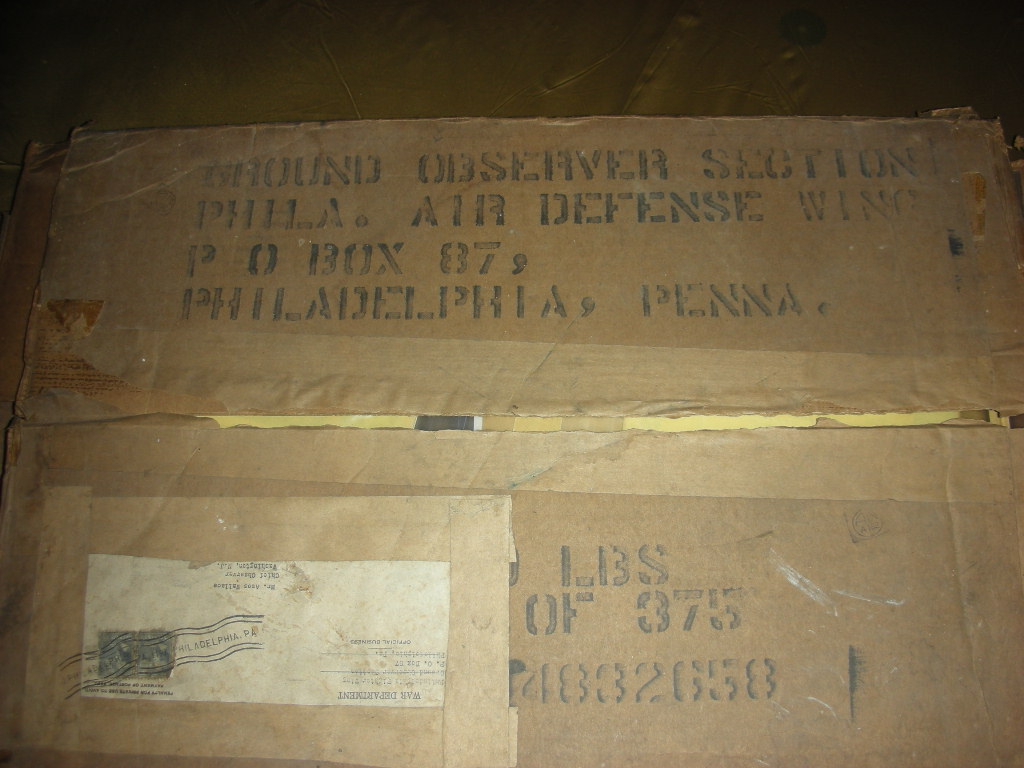
A company called Burton-Rodgers, in Cincinnati, made these silhouette models for the military. B-R was formerly known as "Co-operative Displays", a company founded in 1934. The name was changed in 1943 because displays were no longer the sole product of the company. "Co-operative Displays" continued as a division of Burton-Rodgers, and began offering sets of models to the public, too. This effort began in March 1943, just after the contents of the boxed sets were finalized, and the models were used extensively by "plane spotters" of the Aircraft Warning Service (AWS). The AWS was the civilian branch of the US Army’s Ground Observer Corps. At its peak during 1944, the AWS utilized more than 750,000 civilian participants, stationed along all of our coastlines.
The "Co-operative Displays" models were trademarked "Sil-O-Models". There were 5 sets - A, B, C, D, and E. Each of these had anywhere from 5-9 models in it. “A” was a US Navy set, and contained models of the A-17A, Dauntless, Devastator, Vindicator, Kingfisher, and Wildcat. Set “B” was an Army set, and contained the A-20, A-31, P-38, P-39, and P-40. Set “C” was described as a “Foreign” set, and contained the Beaufort, Hurricane, Spitfire, HE-115K, and ME-109E. Set “D” was an expanded set “B”, with the addition of the B-17, B-24, and C-47. Set “E” was an expanded set “C”, with the addition of the PBY Catalina, Wellington, Defiant, and HE-111. Before you question any apparent inconsistencies, like the A-17A being in the "Navy" box, or the PBY being in the “Foreign” box, you should know that I have each box and am simply quoting from their respective content labels.
These C-D models are exactly the same as their military counterparts, except for markings in the frame which say "Co-operative Displays". The frames of the military models have stamped in them either "Army Air Forces Identification Section", "US Navy Bureau of Aeronautics", or "US Army and Navy Silhouette Model". Regardless of frame markings, all punched-out parts produce the same silhouette model when assembled. All frames came in one of three sizes: Small (7”x11”), Medium (11”x14”), or Large (22”x14”). The dimensions were carefully chosen so that the models could stack/nest. That meant that you could layer them in a box, resulting in a smaller overall parcel size. (See the photos above.) Some models were produced in frames of different sizes over time, such as the P-38, which was issued initially in Medium, but which came out later in the Joint Services sets as a Small.
These models were a creative way to ship a two-dimensional panel from which a 3D model could then be assembled. The process of assembly was intended to reinforce the design elements of the aircraft in the mind of the builder. These ID training models were intended to be viewed from about ~36 feet away. That is about 1/2 mile at scale, and was the effective range of the weapons of the era. At 30+ feet they make for remarkably realistic viewing. See if you can identify the cardboard models in these next photos, taken from only half that distance:
Which Ones?
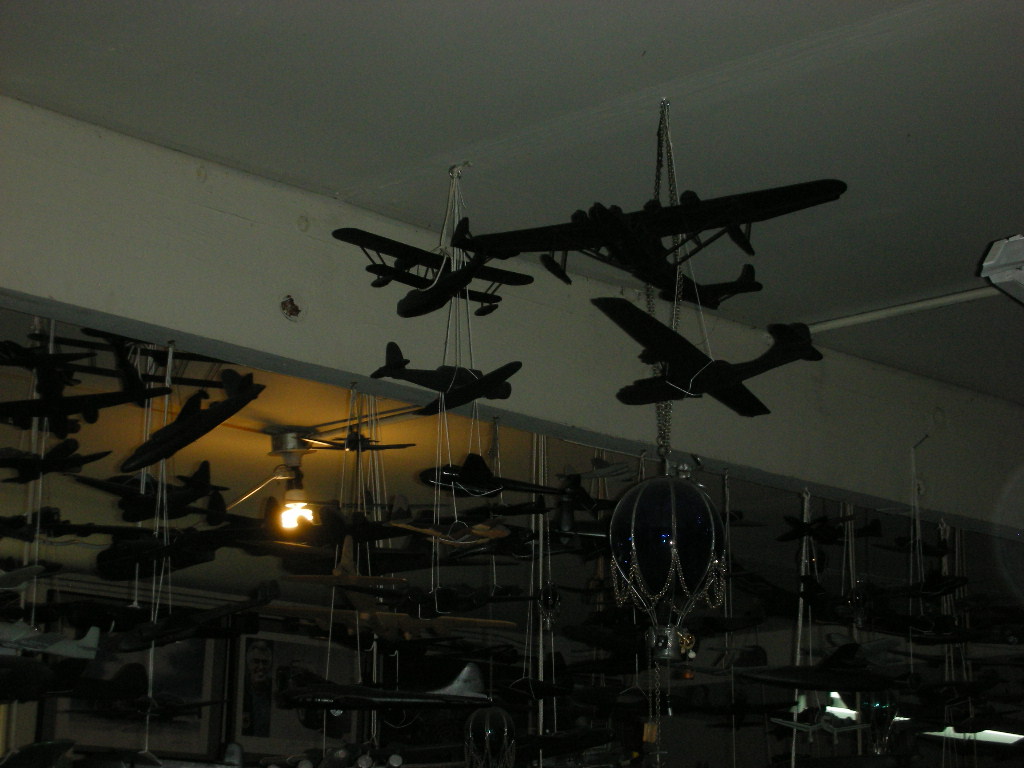
Answer: The Mavis and PBY

Aircraft Warning Service Box: US Navy Set "A"
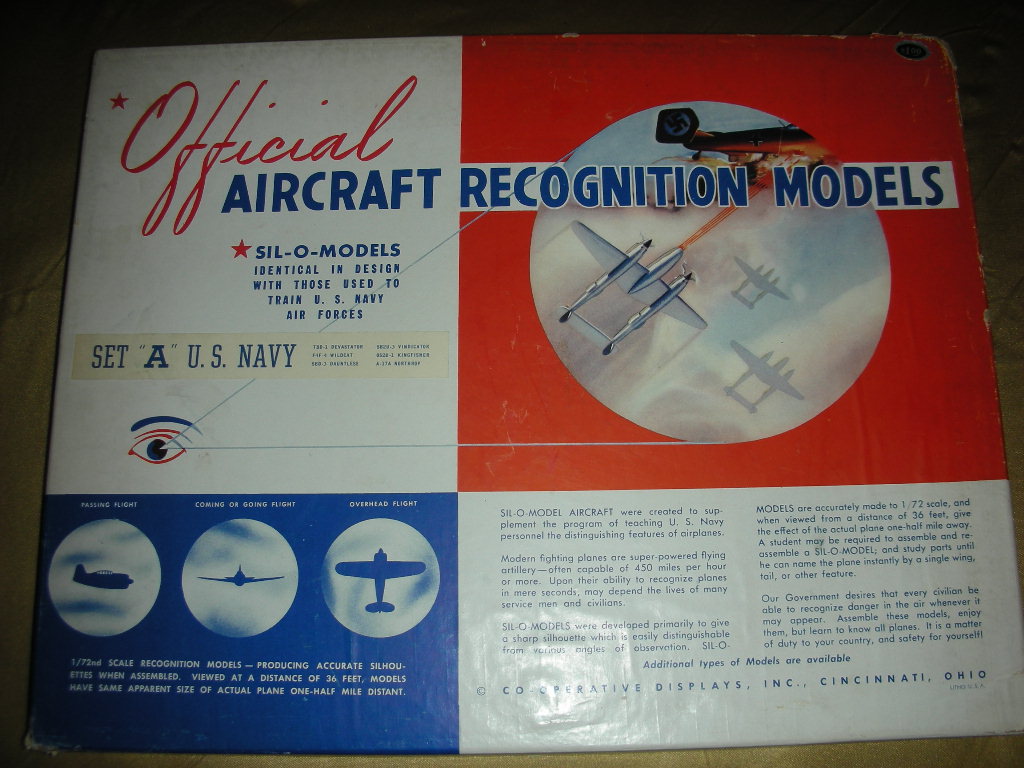
AWS Set "A" Contents

According to published remarks from Burton-Rodgers itself, about 7 million models were produced of 142 aircraft types. The models were cheap, flimsy, and expendable, and many a serviceman whiled away the boring hours crossing the ocean by assembling models and then sailing them over the side of the ship! Not many have survived. In fact, about a dozen of the early S-series models still remain to be identified. The reference numbers exist, but no one knows what planes were assigned those particular numbers.
If you have additional information to contribute, or would like world-record price data for any model, please write to: bwbrown@alumni-gsb.stanford.edu
