Bronzart Identification models

Posted:
Thu Oct 22, 2009 9:15 amby grwebster
I hope our moderator, Bryan Brown can enlighten us on the history of this early { was it the first?} series of US Government contracted and issued models.
I do know that they were made in 1:72nd scale in 'pot' metal, finished in black over an unprimed surface. They were not around long, probably due to their weight.
Today these models are scarce, and while they are metal, they are fragile and one can easily snap off a wing tip if held that way.
Bronzart also made display models but, with some rare exceptions, these did not have the hole through the fuselage and were not painted black.
Some ways to recognize the Bronzart ID models: one is the inscribed writing underneath, usually with the aircraft name and 'Prop. USAAC' . Another is a hole through the center of gravity for hanging. The larger models had a lead weight inserted into the bottom of the rear fuselage for balance.


Re: Bronzart Identification models
Posted:
Fri Oct 23, 2009 9:55 pmby BWBrown
Before the US entered WWII, the US military was closely watching British efforts to teach recognition training, since British involvement in World War II predated our own by more than two years. The US Navy's Bureau of Aeronautics, Special Devices Division, pioneered most domestic identification efforts. As with all models, flash cards, film strips, posters, etc., the intent was to help distinguish friend from foe, and thus avoid incidents of "friendly fire".
One little-known exception to the Navy's virtual monopoly on ID models and collateral training materials was an effort by the US Army Air Corps in about 1940-41 to try to produce their own series of aircraft models. The only known contractor for official Army identification models was the Bronzart Metals Company, of Brooklyn, NY, who produced plane models in white metal comprising the front-line strength of the British, Germans, and the US Army Air Corps. No US Navy aircraft were modeled except for the A-24/SBD Dauntless, which was used by both branches of the service. In addition, Bronzart produced a few examples of Italian and Japanese aircraft, but since Italy and Japan were not yet involved in the conflict these may have been examples intended only to showcase their capability. Data on Japanese aircraft was so scarce and incomplete that Bronzart models sometimes bore little resemblance to the real thing. They even created a model of a fictional fighter - the Sento Ki-001. No models of Russian aircraft are known.
The US Army's Training Aids Division was following the British lead, and UK models typically lacked control surfaces and canopy markings. This was a stylistic choice. Many Bronzart models followed this style, but several incorporated realistic canopy and window markings. None featured control surfaces, however.
Bronzart models apparently were released into military training channels, but had limited distribution and use because of their weight and fragility, and because they used raw materials that could be put to better use. They were very heavy models for their size. The UK Stirling heavy bomber is the heaviest, at more than 4 lbs. Models were sand cast, and sometimes the cores shifted. This produced models lacking a uniform wall thickness. Occasionally, wings have been known to spontaneously fall off untouched. While the models were produced in extremely small numbers to begin with, even fewer have survived today because of the fragile nature of old white metal castings in general. The number of surviving examples of some Bronzart types can be counted on the fingers of one hand. A few exist in known quantities of only 5-10, and only the B-26 Marauder is known to exist in greater numbers today.
The models were sprayed a satin or semi-flat black in color. They were configured for hanging, with a large hole in the bottom (1/4" or larger) and a small hole (1/16") in the top of the fuselage. The large hole was not suitable for a stand, since it was not threaded or reinforced in any way. All models were marked in raised lettering with the name of the aircraft, and some form of "PROP USAC". The Army plans used by Bronzart to produce the series were different from the Navy plans used to produce the cardboard models, the "schoolboy" wood models, and the cellulose acetate models that followed. This means that these metal models are sometimes unique in configuration. One notable example is the B-25, which resembled the first few production aircraft, and thus lacked the gull wing configuration that typifies the Mitchell as most people know it.
Quality of the castings varies. Some are superlative, with a smooth surface and crisp detailing. A few are better representations of the real planes than their counterparts produced in other media to the USN plans. Others are cruder, not only because they lack detailing, but because the finish has a rougher, more pebbly finish. Keep in mind that all 1/72-scale models were intended to be viewed from 33' away. This is about 1/2 mile to scale, and represents the effective range of the weapons of the era. Detailing may make the models more visually appealing to today's collectors, but the presence or absence of detailing had no effect on functionality.
Bronzart, in an effort to capitalize on their Army contract, later removed the "PROP USAC", added a threaded hole for a stand, and offered US aircraft models to the civilian market. These are not uncommon today. Bronzart also went on to make metal models of late-war aircraft. They made manufacturer's models, desktop display models, and some ashtray models, and they made these in a variety of scales. Their only other foray into military training models came in the postwar era, when they made a variety of ship models in 1/500 scale for the US Navy from about 1952 until 1962.
To tell if you have a real WWII Army ID model, and not a later desktop model, manufacturer's model, ashtray model, or an example devoted to some other function, look for the following:
- Must be of an aircraft in front-line combat usage as of 1941. This eliminates planes like the B-29.
- No planes exclusive to the US Navy.
- Must be 1/72-scale, to conform with all other training efforts.
- Must not have control surfaces indicated.
- Must be marked with the name of the aircraft and some form of "PROP USAC" in raised lettering. Keep in mind that the USAC markings were sometimes filed off to avoid issues of ownership, and your model might still be a real one, even if lacking these specific marks. You may be able to tell from a close examination of the casting, particularly if you have stripped off the paint.
- If it is unmolested, it will be neither glossy nor flat in sheen, but somewhere in between.
A variety of other types of metal models can be seen in the marketplace. These are sometimes copies of the Cruver models in cellulose acetate, with control surfaces and a date. These may also be postwar models from the NATO series that was produced for the Korean War, and which featured many aircraft that also played a role in WWII. Models of any USN aircraft probably fall into this category.
For another source of information, consult "The Plane News", Issue #11, Fall 1991, published by G.R. Webster, and with an article titled "Bronzart Recognition Models - A Collector's Primer", by Andy Harris.
Following is a list of models in the series that are known to exist, so far. Others may exist, like the P-38 Lightning and Hurricane, but have yet to surface. If you have information about other examples, please let me know and I will add them to this list. For detailed photos of any example, or with any other questions, please contact me.
US ARMY: A-20B HAVOC, A-24 DAUNTLESS, A-29 HUDSON, A-31 VENGEANCE, B -17E FLYING FORTRESS, B-24 LIBERATOR, B-25 MITCHELL, B-26 MARAUDER, P-39 AIRACOBRA, P-40F WARHAWK, P-47 THUNDERBOLT.
UK: BEAUFIGHTER MK. I, BLENHEIM MK. IV, SPITFIRE MK.I, STIRLING, WELLINGTON 3
GERMAN: DO-217E, FW-187, FW-190, FW-200 KURIER, HE-111K, HE-177, JU-52 (wheels), JU-52 (floats), JU-87B, JU-88, ME-109E, ME-109F, ME-110.
ITALIAN: G-50, MC-202
JAPANESE: SENTO KI-001 (BEN - fictional), NA. 96 (CLAUDE), NA. 19 KI-21 (SALLY), KARIGANE (SONIA), BAKU GEKI KI-99 (VAL), MIT. 00 (ZEKE).
Best wishes! -- Bryan
Re: Bronzart Identification models
Posted:
Wed Oct 28, 2009 12:33 pmby angelreader
Fantastic historical appraisal Bryan,we are so honoured to have you here with your expertise in these highly specialised models,thank you,Barry.
Re: Bronzart Identification models
Posted:
Wed Oct 28, 2009 2:40 pmby grwebster
I agree, that is the best summary I have ever read, many thanks Bryan for posting it.
I have this model which I suspect is a bronzart, it has no clear underside lettering but there is the hole for the lead insert. Is it one?


Re: Bronzart Identification models
Posted:
Wed Oct 28, 2009 2:44 pmby grwebster
Re: Bronzart Identification models
Posted:
Thu Oct 29, 2009 5:02 pmby BWBrown
Hi GR -
Your HE-111 certainly looks like a Bronzart model to me. Markings are sometimes faint or difficult to read because the mold became partially filled in. Look at the markings on my model. Some letters you can read, while others you have to take on faith. I believe I can see "AC" on the bottom of yours, and more might be visible with better lighting or a change in viewing angles. Looks authentic to me from where I sit!
Regards! -- Bryan
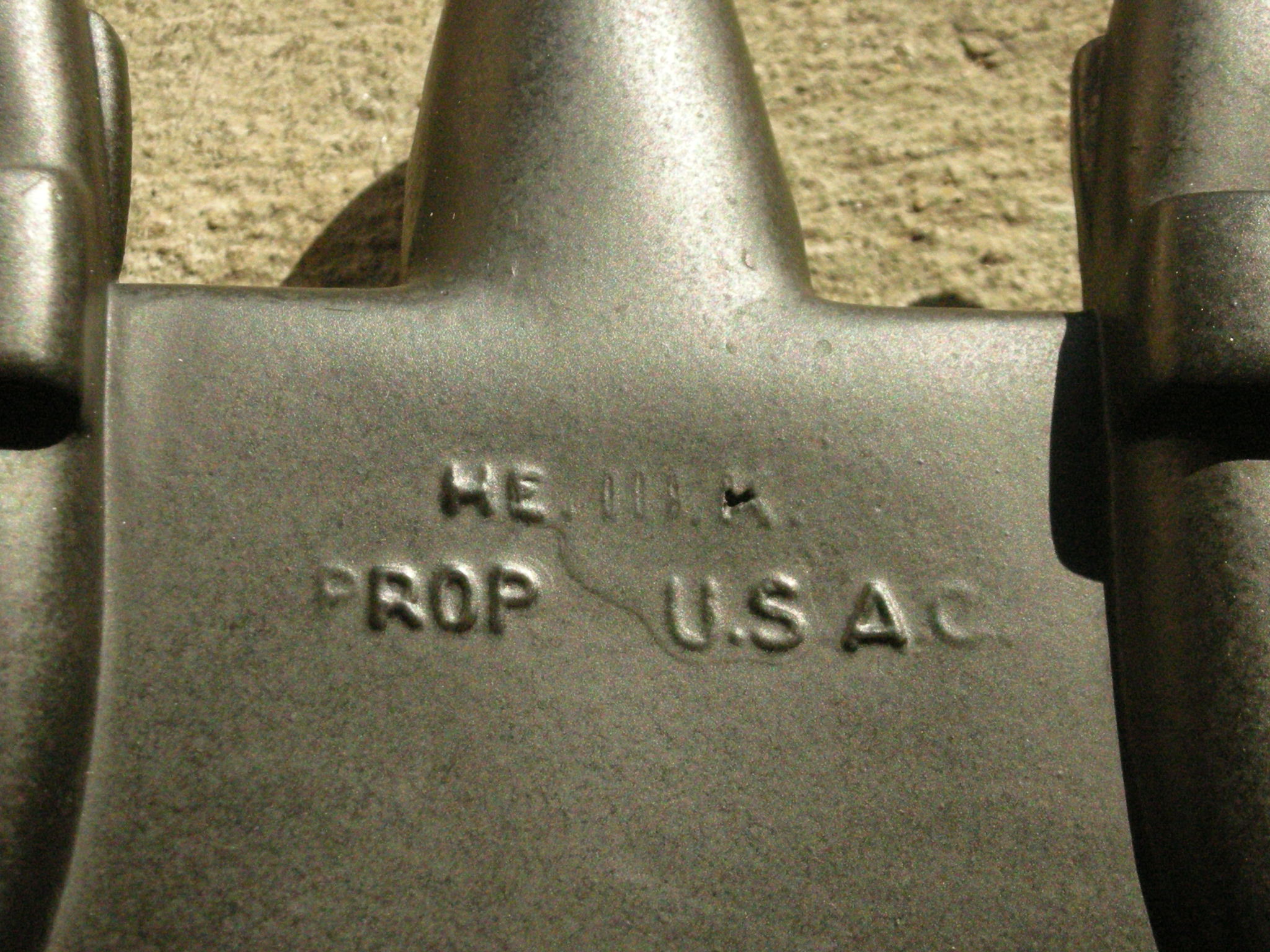
- HE-111.JPG (599.19 KiB) Viewed 16712 times
Re: Bronzart Identification models
Posted:
Thu Oct 29, 2009 7:37 pmby fliegerii
This is a wonderful riddle solved. If you look very closely to GR's pic, you can even see the "HE III" lettering in the correct position! Great topic!
Re: Bronzart Identification models
Posted:
Fri Oct 30, 2009 5:31 amby car15
Is this a Bronzeart ID model?
Re: Bronzart Identification models
Posted:
Fri Oct 30, 2009 9:09 amby admin
Thanks Bryan and Chris for the confirmation on the he-111 being a bronzart.
BTW I am in North Africa along the Algerian border with Tunisia, north edge of the Sahara Desert and it takes forever to get a page to load. I might not bother any more till I return to France in 8 or 9 days.
Re: Bronzart Identification models
Posted:
Sat Oct 31, 2009 12:29 amby BWBrown
This could be a model made by Bronzart, but it is probably not an ID model. Military training models were utilitarian devices, intended to be subjected to great abuse in the field. I have never seen a true military ID training model, regardless of construction medium, that had propellers. These were just too fragile and exposed to last in a training environment. New information about these old things surfaces every year, however, so I'd be happy to be proven wrong at some point. Based on today's knowledge of the genre, this is a model intended for some other purpose than military training. If you have more close-ups I'd love to see them! Thanks! - Bryan